
Key Takeaways
- The choice between generative engine optimization (GEO) and search engine optimization (SEO) isn’t either-or. The two disciplines complement each other.
- SEO earns rankings in traditional search results. GEO builds the depth and authority that earn your content citations in AI-generated answers across platforms like ChatGPT, Perplexity, and Google’s AI Overviews.
- Answer engine optimization (AEO) and large language model optimization (LLMO) round out the picture.
- AEO helps structure your content to become the direct answer in AI-powered search experiences, from featured snippets to AI Overviews and tools like ChatGPT. LLMO shapes how large language models (LLMs) understand and describe your brand.
- Google considers AI optimization “still SEO” because “optimizing for generative AI search is optimizing for the search experience.”
- To build a combined strategy, start with your SEO foundation. From there, structure pages for AEO and deepen content for GEO. Consistent brand information across the web supports LLMO.
If you’ve been doing SEO for a while, you’ve probably noticed a shift. SEO is no longer the only factor to consider in search visibility.
According to Ahrefs research, Google’s AI Overviews are associated with a 58 percent lower click-through rate for top-ranking pages.
AI-powered search is reaching a massive audience. Google reports that AI Overviews has more than 2.5 billion monthly users, while AI Mode has already passed 1 billion monthly users.
At the same time, people are skipping Google altogether and using tools like ChatGPT, Perplexity, and Gemini for answers and recommendations.
That’s created a wave of new terminology: GEO, SEO, AEO, LLMO, and so on. Keeping it up with it all can feel overwhelming.
Each covers a different search surface that SEO wasn’t built for. They don’t replace SEO, but you also can’t rely on SEO alone.
I get questions all the time about how SEO, GEO, AEO, and LLMO relate to one another and when each one matters. If you’re asking those same questions, this guide is for you. We’ll start with GEO vs. SEO as the foundation, then layer AEO and LLMO on top.
Defining the Four Disciplines
SEO, GEO, AEO, and LLMO each target a different surface:
- Search engine optimization is the process of improving your site so it ranks higher in search results. It relies on content quality and site structure, backed by strong backlinks and solid technical performance, to earn visibility in Google and other engines.
- Generative engine optimization focuses on getting AI tools to cite or recommend your content in their answers. Those include Google’s AI Overviews and AI Mode, ChatGPT, Perplexity, and Gemini. GEO emphasizes depth and expertise because generative systems prioritize trustworthy, well-supported content. Fresh, up-to-date information also carries more weight in these systems.
- Answer engine optimization helps your site appear as a direct answer in search results. That covers featured snippets, People Also Ask boxes, knowledge panels, voice assistant responses, and AI-generated answers in tools like ChatGPT and Google’s AI Overviews. AEO relies on clear, structured content, like FAQs and schema markup. It’s ideal for high-intent, question-based queries.
- Large language model optimization shapes how AI models understand and describe your brand. LLMO is built on clear entities and original insights paired with a consistent brand presence across platforms.
GEO vs. SEO vs. AEO vs. LLMO: Side-by-Side Comparison
Each discipline works differently and measures success differently. Here’s how they compare side by side.
| SEO | GEO | AEO | LLMO | |
| Primary goal | Rank higher in search results and earn clicks | Get cited in AI-generated answers | Win the direct answer to a specific question | Shape how AI models describe your brand |
| Search surfaces | Google and Bing organic results | Google AI Overviews and AI Mode, ChatGPT, Perplexity, and Gemini | Featured snippets, People Also Ask, knowledge panels, voice assistants, and AI-generated answers (as the extracted direct answer) | Conversational answers in ChatGPT, Claude, Gemini, and Perplexity |
| Content style | Keyword-focused pages built around search intent | In-depth, well-sourced long-form content | Question-based headers with short, direct answers | Expert insights with consistent brand terms |
| Key signals | Backlinks, technical health, and content quality | Depth, expertise, freshness, and third-party mentions | Clear structure, Q&A formatting, and schema markup | Entity consistency and original insights supported by cross-platform presence |
| Success metrics | Rankings, organic traffic, and click-through rate | AI citations, brand mentions, and share of voice | Featured snippet and People Also Ask appearances | Brand mentions and how AI describes you |
| Speed to results | Gradual, then compounding | Gradual, tied to authority | Fastest of the four approaches | Slowest of the four approaches |
| Best for | Every site, as the foundation | Long-form guides, thought leadership, and original research | Pricing, how-to, comparison, and FAQ queries | Brands competing on authority and expertise |
GEO vs. SEO: What Changes When AI Enters the Picture
GEO and SEO share the same mission of getting useful, credible content in front of the right audience. The mechanics differ, but the fundamentals overlap.
Here’s where they connect:
- Both are built around user intent. You win by matching the question behind the query, not by chasing vague head terms.
- Content quality drives outcomes. Original research and current stats increase usefulness, especially when paired with step-by-step guidance readers can act on. Covering a topic in depth is how you build topical authority.
- Structure increases visibility. Descriptive headers and short paragraphs help crawlers and AI models process your content. Ordered lists and clear tables are especially useful for queries where users need to compare options or follow steps.
- Experience, expertise, authoritativeness, and trustworthiness (E-E-A-T) signals matter. Named authors with real credentials build trust with search engines and AI tools alike. Transparent sourcing reinforces that trust by showing where your claims come from.
- Strong technical foundations help both. Fast load times and mobile readiness make content easier to discover. Logical internal linking and clean URLs help search engines and AI models parse your site structure.
- Schema and metadata add clarity. Relevant schema types help search engines interpret your pages, and clear titles paired with concise meta descriptions give them the context to surface your content accurately.
Where GEO and SEO diverge is in what success looks like and how you get there.
Output and Measurement
SEO aims to win clicks from a list of website links. GEO focuses on being included in AI-synthesized answers.
That changes how you think about traffic. Organic visits can drop, but your conversions may hold steady or even improve.
An analysis of 94 ecommerce sites finds that visitors referred by ChatGPT convert 31 percent better than those arriving through non-branded organic search.
One possible explanation? AI tools help users research and compare options before they visit your site. So, by the time someone clicks through, they may already be closer to making a decision.
Say you run a software company and lose traffic on how-to posts after AI Overviews start answering those questions directly. If demo requests remain strong, the traffic you lost wasn’t driving business anyway.
All that to say, you can’t judge GEO by traffic alone. Track conversions, leads, and branded searches alongside it.
Signals of Value
Traditional SEO still leans heavily on backlinks as proof of authority. GEO values content clarity and freshness, but it also weighs where your brand shows up beyond your own site.
AI platforms pull heavily from community-driven sites like Reddit and Quora, along with news outlets and trusted publishers.
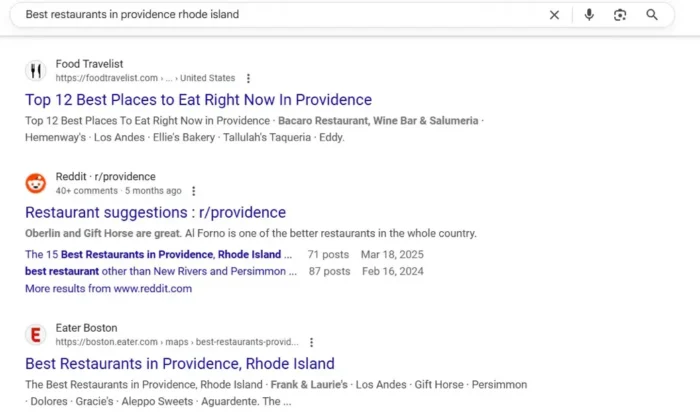
A Peec AI analysis of 30 million AI search sources finds that Reddit is the most-cited domain, while Wikipedia and Forbes also rank among the top five.
If your brand is only visible on your own blog, you risk being left out of those AI answers. Getting mentioned on the platforms AI systems draw from strengthens both your GEO and SEO.
Best Practices
SEO requires long-term link building and strong technical health, anchored by evergreen content that holds its value over time.
GEO builds on that with question-based keyword targeting and multimedia elements AI can parse. It also puts more emphasis on distribution across the platforms AI systems draw from, with Peec’s analysis finding YouTube and LinkedIn right behind Reddit in the top three most-cited domains across major AI search platforms.
High rankings used to mean visibility. Now, visibility also depends on whether your brand shows up in AI engines.
Where does that leave the GEO-SEO relationship? GEO doesn’t replace SEO. The same content quality, authority, and structure that earn Google rankings tend to earn AI citations. Google even says optimizing for its AI features is “still SEO.”
Rankings don’t guarantee a citation, though. Still, Google only links to pages in its AI features that are indexed and eligible to show in Search with a snippet. If your pages are hard to crawl or lack authority, they’re less likely to appear as a citation.
SEO still builds the foundation. GEO makes sure the foundation carries into AI-driven search.
AEO vs. SEO vs. GEO: The Quick-Answer Discipline
SEO gets your pages ranked. GEO gets your pages cited in AI summaries. AEO is the third layer of strategy that makes you the direct answer to a user’s question.
AEO structures your content so search engines and AI tools can extract a clear answer from it, whether that’s a featured snippet, a People Also Ask box, a voice search response, or an AI-generated result. Where GEO serves broad, exploratory searches that call for deeper context, AEO serves question-based intent (“what is,” “how to,” “how much does”).
AEO can also be implemented faster, as structural content updates like descriptive headings or concise answers tend to be quick fixes. Question-based queries are where those content changes show up first.
The difference between AEO and SEO boils down to what you optimize for.
Instead of optimizing only for rankings, AEO prioritizes structure, clarity, and answer-ready formatting. AEO focuses on creating content that’s clean, relevant, and easy to parse.
Businesses answering high-intent queries (like “how much does X cost” or “what is the best Y for Z”) see fast results with AEO.
Winning that coveted spot in a featured snippet requires structural changes that rankings don’t account for, like:
- Writing content around specific, searchable questions
- Using headers that mirror the way people search
- Following each question with a short, clear answer. Aim for two to four sentences
- Using bullet points, numbered lists, or short paragraphs to improve scannability
Schema markup helps search engines understand the page, too.
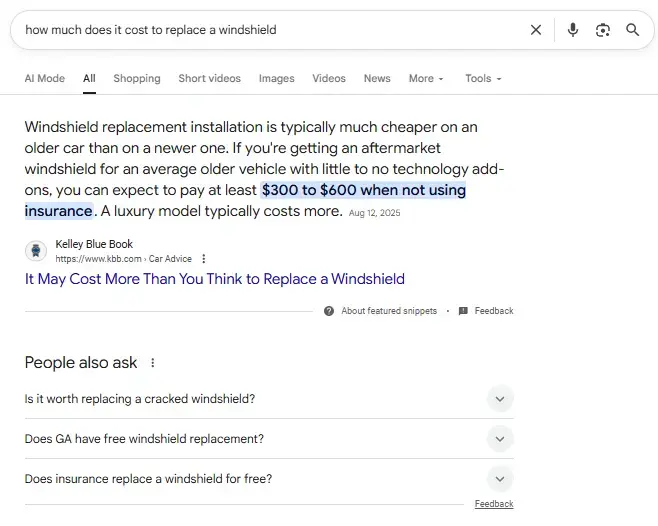
Say you have an automotive business. On a service page, you add a header that says, “How much does it cost to replace a windshield?” Below the question, you give a two-sentence answer with a typical price range and factors that affect the cost, like the example below.
That clear question-and-answer format is what Google looks for when it fills a featured snippet or a People Also Ask box.
When Do You Use AEO vs. GEO?
Use AEO for short, high-intent questions with one clear answer, like:
- “How much does it cost to replace a windshield?”
- “How do I reset my router?”
- “What is a 401(k)?”
Use GEO for broad or exploratory questions where people want depth and context, like:
- “How is AI changing B2B marketing?”
- “Is solar worth it for a home in Arizona?”
- “What’s the best way to choose a CRM for a small sales team?”
Structure the page for AEO first with clear Q&A formatting. Then deepen it for GEO with expertise signals and citations that keep the content fresh and well-supported.
LLMO: Optimizing for Conversational AI
SEO, GEO, and AEO all optimize for where you show up. LLMO optimizes for what AI tools say about you when you do.
The difference between LLMO and GEO is subtle. GEO gets you cited as a source in AI-generated answers. LLMO helps dictate how ChatGPT, Claude, Gemini, and Perplexity describe your brand when someone asks about it.
For example, a user asks ChatGPT for the best backpacks for work. GEO affects whether AI cites your page as a source. LLMO affects whether LLMs name your brand among the backpacks they recommend and how they describe your product.
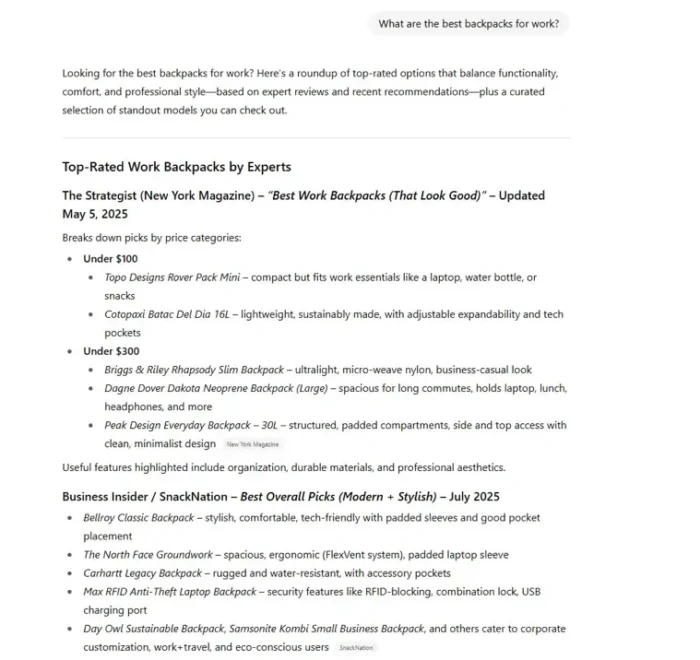
LLMO works by helping large language models understand your brand as a clear, consistent entity. Repeat key terms across credible sources, and models become more likely to reference your business in conversational responses.
In practice, that means:
- Use the same brand names and product names everywhere you appear online. Keep descriptions consistent, too.
- Publish original research and frameworks that LLMs can reference. Proprietary data is especially valuable because it gives models something they can’t find elsewhere.
- Add strong author bios with real credentials, like the example below from the NeilPatel.com blog.
- Appear on LinkedIn, in industry publications, and on review sites so LLMs see consistent information from several sources.
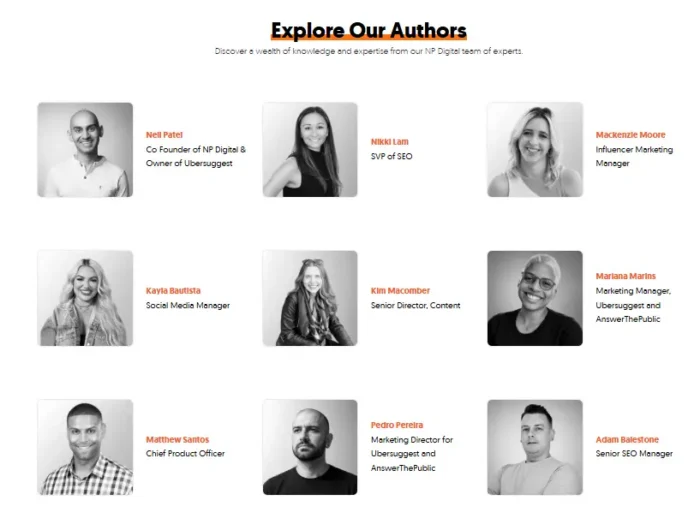
Consistency’s a big deal. If your website calls your product a CRM and review sites call it a sales tool, LLMs may describe you two different ways.
The clearer your entities are, the easier it is for AI models to recognize and reuse your content accurately.
LLMO matters most for brands that compete on authority and expert positioning, especially if they depend on AI tools to represent them accurately. A vague or inaccurate AI description can mean a lost prospect who never visits your site.
Thankfully, LLMO and GEO work together. The same depth and authority signals that earn AI citations also shape how AI describes your brand.
When to Prioritize Each Discipline
Not every business needs the same optimization approach. SEO, AEO, GEO, and LLMO support different goals, so the starting point depends on your business model, audience, and growth targets.
Start with SEO First
SEO is the foundation GEO, AEO, and LLMO are built on. If your site has technical issues, thin content, or weak authority, the other three will underperform no matter how well you optimize.
Fix the foundation first. Site speed and clean crawlability make your content easy to find, and strong E-E-A-T signals give search engines a reason to trust it. A comprehensive keyword and content strategy ties it all together.
Layer in AEO for Quick Wins
AEO should lead when your content relies on capturing direct, question-based searches. Start with existing pages. Find pages that target questions, then add question-based headers and direct answers below them.
AEO is the strongest fit for:
- Local and service businesses answering specific queries
- Product-led brands solving practical “how to” or “what is” searches
- Product comparisons and cost-related queries
- FAQ-style support content
Build GEO into Long-Form and Authority Content
GEO plays a bigger role when your strategy depends on depth and credibility. It also compounds over time. Invest in GEO for:
- Long-form guides and evergreen content
- Thought leadership and expert breakdowns
- Original research and data
- Broad topics where AI tools need depth and trustworthy sources
Publishing on a regular cadence with credentialed authors helps build authority over time. Outbound citations and fresh, up-to-date information signal to AI systems that your content is trustworthy. For a deeper look at what works, here’s our guide to GEO best practices.
Add LLMO as Brand Authority Matures
LLMO is usually the last layer because it takes the longest to build. AI models need to see your brand represented consistently across the web before they’ll recommend you by name or describe you accurately.
That kind of presence doesn’t happen overnight. It requires original expert content built on clear entity signals and steady visibility across credible sources, all of which grow naturally as your SEO, AEO, and GEO efforts mature.
How to Optimize for GEO, SEO, AEO, and LLMO Together
You don’t need four playbooks to optimize for SEO, AEO, GEO, and LLMO. The most efficient approach is building one content system that naturally supports all four.
Audit Your Starting Point
Before you start optimizing, assess how you’re performing. An AI audit shows where your content already appears in AI answers and where it’s missing. That means checking whether AI tools mention your brand and how they describe you.
Once you know your gaps, work through each layer in order, starting with SEO.
Lock Down the Technical Foundation
A fast site with clear navigation and clean URLs is still the backbone of modern visibility. Solid internal linking helps search engines and AI systems alike find and interpret your content. Layer in keyword targeting and quality content, and these basics make sure your content is discoverable no matter which AI-driven system tries to interpret it.
Structure Pages for Direct Answers
Place question-based H2 and H3 headers near the top of your content, and put a direct answer right below each one. Give the reader something useful in the first two to four sentences, then expand.
Key Takeaways sections are a great starting point. A short list of direct answers at the top of the page immediately gives readers and search engines the main points.
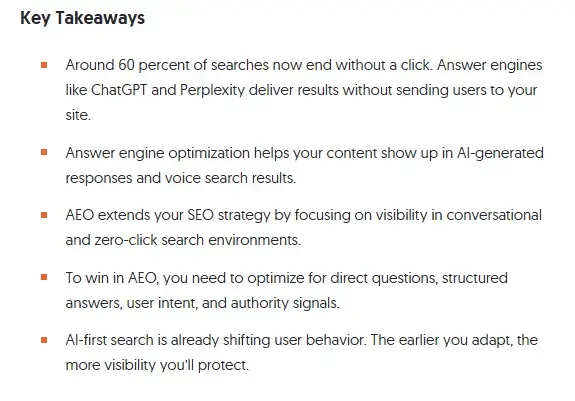
Add an FAQ section to cover related questions, and use FAQ and HowTo schema markup so search engines can read the page structure clearly.
Build Depth That AI Systems Can Cite
After the quick answers, build out deeper explanations and research-backed analysis. This is what generative AI pulls from when it constructs answers, so give it something substantial to work with.
That depth still needs to be organized so AI systems can find the good stuff.
Think of it as the inverted pyramid. Lead with your strongest answer and follow with supporting details. Background context and nice-to-know information can come last. AI systems tend to favor content that’s easy to find and clearly structured, so putting your best answer up front gives it the best chance of showing up.
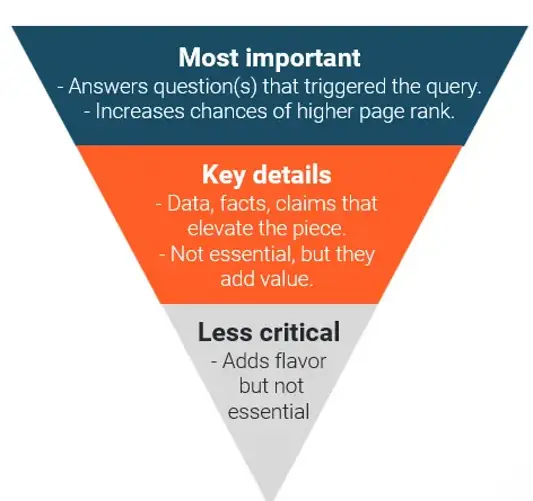
Back up your claims with reputable outbound links and include named authors with real credentials. Show a visible “last modified” date so AI systems can assess freshness. Original data can earn AI citations, too, but structure it so AI tools can extract it easily.
Strengthen Your Brand as an Entity
Reinforce consistent terminology and brand descriptions sitewide. Expert bios with real credentials should appear on every piece of content you publish.
Then expand beyond your own site. Appear on LinkedIn, in industry publications, and in research others cite. The more consistent your brand looks across credible sources, the more confidently AI models will recommend you.
Putting It All Together
Here’s an example of how all four disciplines work together in this context. Say you’re updating a guide about home solar panel costs.
- You start with your SEO foundation, making sure the page loads fast and targets the right keywords.
- Then you add AEO structure. Right beneath the first header, you clearly answer, “How much do solar panels cost?”
- GEO comes next. You add a cost breakdown by state, a named energy expert, and links to the data behind it.
- Finally, you check LLMO. That might mean keeping your company name and service descriptions consistent with your LinkedIn page and press coverage.
How to Measure ROI Across GEO, SEO, AEO, and LLMO
Each discipline uses different success metrics, and no single metric captures the full picture. Here’s what to track and how to read the results together.
SEO
Key metrics include keyword rankings, organic traffic, and click-through rate, plus conversions from organic search. Track conversions and revenue from organic search where you can, too, since those are what demonstrate return on investment (ROI). These numbers are your baseline for everything that follows.
GEO
For GEO, you measure success by brand visibility in AI outputs, including citations, mentions in AI results like AI Overviews, and sustained brand presence across AI-driven platforms. Share of voice in AI answers matters, too.
On Google, Search Console’s Generative AI performance report shows how often your pages appear in AI Overviews and AI Mode. For other platforms, run manual prompt checks or use a tool like Ubersuggest’s AI visibility feature.
AEO
For AEO, track featured snippet appearances, People Also Ask inclusions, and voice search mentions. For AI-generated results, monitor how often your content is surfaced as the direct answer in tools like AI Overviews and ChatGPT.
Google Search Console doesn’t break out featured snippets specifically, so check your target questions by hand or with a rank tracker that reports search features. AEO results tend to appear before GEO results, since structural fixes are quick to make.
LLMO
For LLMO, track how often AI tools mention your brand and how they describe it. Look for consistency across platforms.
Tools like Ubersuggest’s AI visibility feature can help you monitor this at scale. Manual prompt testing across ChatGPT, Claude, Gemini, and Perplexity is still useful for spot-checking accuracy, but it’s no longer the only option.
Reading the Metrics Together
After you’ve tracked each discipline individually, look at them side by side over the same time period. The patterns between metrics tell you more than any single number.
If AI citations rise while organic traffic drops, your overall visibility is likely growing, even though the traditional metric is down. If AEO wins come quickly but GEO citations stay flat, your pages may answer the question without giving AI models enough depth to cite. If AI citations and organic traffic drop at the same time, the problem is likely content quality or authority.
Set up AI search visibility monitoring once so comparisons are easier to spot.
Common Mistakes When Implementing These Strategies
I see a lot of businesses making mistakes with SEO, AEO, GEO, and LLMO. Here are some of the most common pitfalls:
- Treating them as mutually exclusive. You don’t pick one optimization path and ignore the others. Your FAQ page needs AEO. Your comprehensive guide needs GEO. Most content benefits from all four approaches applied strategically.
- Optimizing for machines at the expense of humans. AI models favor content that serves real people. Write for humans first, then add the technical elements that help machines understand.
- Ignoring content freshness. This hurts GEO and LLMO the most. AI models prioritize current information. If you haven’t updated your comprehensive guide in two years, it’s less likely to get cited. Set a schedule to review and refresh your content.
- Skipping schema markup for AEO. FAQ and HowTo schema take minutes to implement, and they help search engines understand how your page is structured.
- Not tracking results separately. You need to know which strategy drives which outcomes. Watch rankings and traffic for SEO. Track featured snippet appearances for AEO content. Monitor AI Overview citations for GEO pieces. Check how AI tools describe your brand for LLMO.
- Assuming SEO rankings automatically carry over to AI visibility. High rankings can improve your chances of getting cited, but they’re no guarantee. An Ahrefs study finds that only 37 percent of URLs cited in Google’s AI Overviews also ranked in the top 10 organic results for the same query. That’s why GEO and LLMO deserve dedicated attention alongside traditional SEO.
The biggest mistake? Doing nothing because you’re overwhelmed. Start small. Pick a piece of content for each type of optimization, then measure the results. Learn what works for your audience, then scale from there.
FAQs
Are AEO and GEO different things?
Yes. AEO focuses on structuring content for direct answers in search results, like featured snippets or People Also Ask boxes. GEO is about creating trustworthy, in-depth content that AI tools can summarize or cite.
Are AEO and GEO the same?
No. AEO and GEO both build on SEO, but they focus on different things. AEO structures the top of the page for quick answers, and GEO adds the content depth that AI tools cite.
Can SEO and GEO strategies work together for better results?
Yes. GEO builds on a strong SEO foundation. You still need SEO for rankings and discovery. GEO adds an extra layer to make your content usable in AI-driven outputs.
How do you measure the ROI of GEO and AEO work?
Track each one separately. GEO success shows up in citations in AI responses, brand mentions, and visibility across AI-powered platforms. AEO success shows up in featured snippets and People Also Ask appearances. Then, compare both against your organic traffic and conversions.
Do I need both SEO and GEO for my website?
Yes. SEO gets you visibility in search results, but now that AI summaries answer more searches directly, GEO helps increase your chances of being included in those responses.
Conclusion
SEO, GEO, AEO, and LLMO are layers of the same system, each one built to reach people in a different place. All four help you get your content in front of the right people regardless of how they search.
.SEO lays the foundation. AEO wins the quick answers. Strong SEO content becomes the source material that earns GEO citations, and those citations build the brand authority that gets you recommended by name in conversational AI.
You don’t need to do everything at once. Update a handful of pages and test each layer, and use that information to build from what works.
Want help optimizing for all four? Check out my SEO consulting services for hands-on support with building your strategy.
Pôvodne publikované na neilpatel.com