AI Boom at Risk as Trump Threatens “Tremendous Tax” on Overseas Data Centers While Restrictions Mount at Home

America’s artificial intelligence boom is running into an obstacle that even billions of dollars can’t easily overcome: finding somewhere to build the infrastructure.
Technology companies are spending hundreds of billions on data centers to power increasingly sophisticated AI systems. Yet communities across the country are rejecting projects over electricity costs, water consumption, and land use.
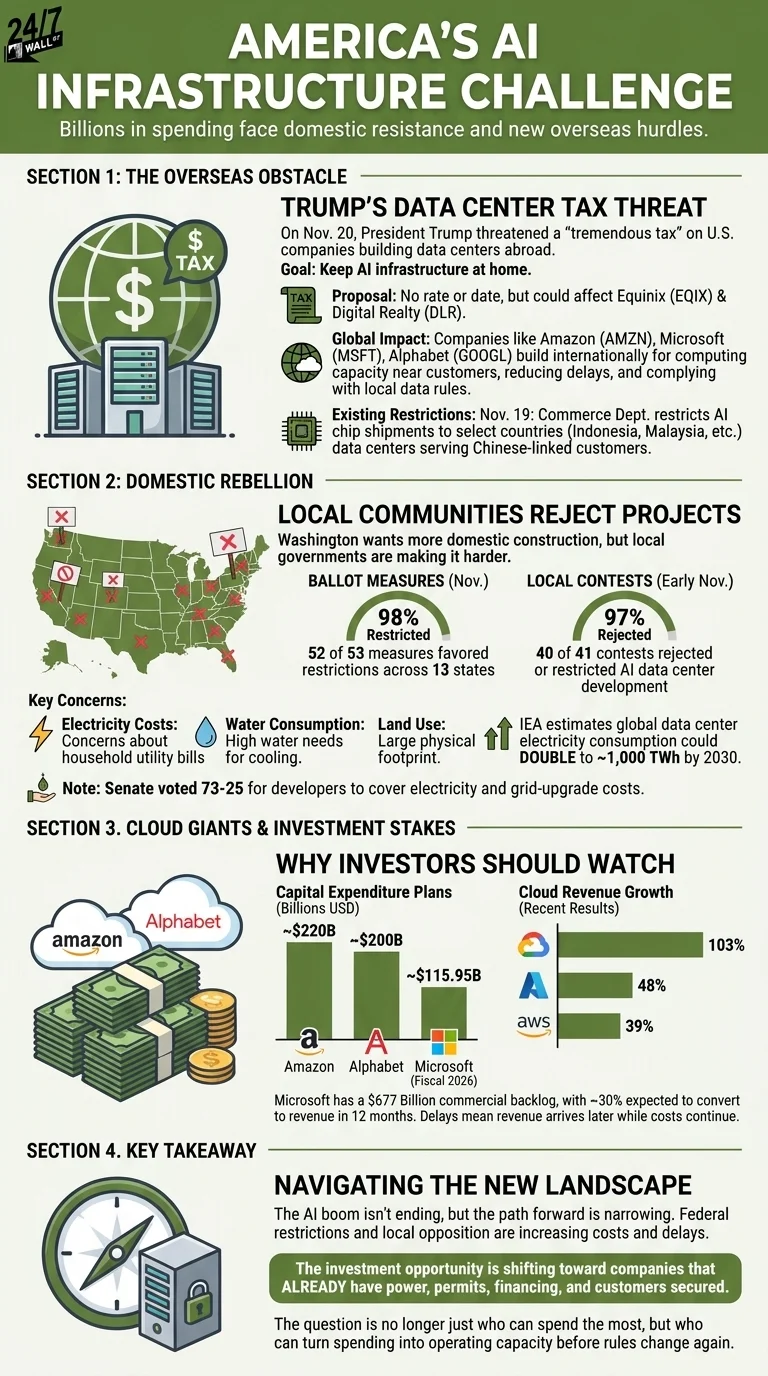
Now President Donald Trump wants to make building overseas more expensive, too. On Nov. 20, Trump threatened a “tremendous tax” on American companies constructing data centers abroad. His stated goal is keeping America’s AI infrastructure at home.
The problem is that Washington wants more domestic construction just as local governments are making it harder.
Trump’s Data Center Tax Threat Changes the Equation
Speaking at a White House news conference, Trump declared that American companies should build their data centers in the United States rather than overseas.
He provided no tax rate, implementation date, or legal mechanism. Reuters reported that the proposal could affect companies such as Equinix (NASDAQ:EQIX) and Digital Realty (NYSE:DLR), which operate data centers internationally.
These facilities aren’t simply being built abroad to escape American regulations. Companies need computing capacity near international customers to reduce transmission delays and comply with local data requirements.
Amazon (NASDAQ:AMZN), Microsoft (NASDAQ:MSFT), and Alphabet (NASDAQ:GOOGL) all operate global cloud networks serving customers across multiple continents. A tax on overseas construction could raise their costs or force them to reconsider expansion plans.
And the threat follows actual regulatory restrictions. On Nov. 19, the Commerce Department’s Bureau of Industry and Security published new rules requiring licenses for certain advanced AI chip shipments to Indonesia, Malaysia, Singapore, Thailand, and Brazil. The rules also restrict overseas data centers supplying advanced computing capacity to certain Chinese-linked customers.
Unlike Trump’s proposed tax, these export restrictions are already in effect. The administration is trying to protect America’s AI advantage, but the combined policies could make expanding that advantage more expensive.
America’s Data Center Building Boom Faces a Domestic Rebellion
The overseas restrictions might be easier to absorb if developers could simply build more facilities at home. Unfortunately, that’s becoming harder.
According to Ballotpedia, voters favored restrictions on data center development in 52 of 53 ballot measures across 13 states during the November elections.
Earlier this month, voters rejected or restricted AI data center development in 40 of 41 local contests.
The opposition isn’t necessarily against artificial intelligence. Residents are concerned about who pays for the infrastructure supporting it. Data centers require enormous electricity supplies, cooling systems, and transmission upgrades. Communities worry those costs will eventually appear on household utility bills.
The International Energy Agency estimates global data center electricity consumption could double to approximately 1,000 terawatt-hours by 2030.
Meanwhile, the U.S. Senate voted 73-25 to advance legislation requiring data center developers to cover their electricity and grid-upgrade costs.
That creates a difficult situation. Companies face growing resistance to domestic construction while Washington threatens penalties for building elsewhere.
Why Investors Should Watch the Cloud Giants
The financial stakes extend well beyond data center landlords. Amazon plans approximately $220 billion in capital expenditures this year, while Alphabet expects around $200 billion, according to company guidance cited by 24/7 Wall St. Microsoft’s fiscal 2026 capital spending reached $115.95 billion.
These investments are intended to support rapidly expanding cloud businesses. Recent company results show why management teams keep spending:
| Company | Cloud Revenue Growth |
| Alphabet — Google Cloud | 103% |
| Microsoft — Azure | 48% |
| Amazon — AWS | 39% |
Those growth rates explain the urgency. Demand for computing power remains strong, but physical infrastructure takes time to construct.
Microsoft reported a $677 billion commercial backlog, with approximately 30% expected to convert into revenue within 12 months. That backlog offers visibility, but turning AI spending into profitable revenue depends on getting computing capacity online.
Delays mean revenue arrives later while financing, equipment, and construction expenses continue. Smaller operators relying on borrowed money could face greater pressure than technology giants financing projects through operating cash flow.
Key Takeaway
Trump’s overseas data center tax remains a proposal, not an enacted policy. Investors shouldn’t assume every international project will suddenly face new penalties. But the direction is unmistakable. Federal restrictions, local opposition, and rising infrastructure costs are narrowing the options for America’s AI developers.
The AI boom isn’t necessarily ending. Demand for computing power continues to grow. The investment opportunity is shifting toward companies that already have power, permits, financing, and customers secured. Those advantages could become more valuable as building the next data center gets harder.
For investors, the question is no longer simply who can spend the most on AI. It’s who can turn that spending into operating capacity before the rules change again.
Released: The Definitive Guide to Retirement Income
(Sponsor) Most people spend their entire working lives focusing on one thing: growing a pile of money. Then they retire and discover the skill they actually need is close to the opposite. Turning that pile into steady income, year after year, through good markets and bad, without ever running out.
It may be the least discussed and most consequential transition in personal finance, and plenty of otherwise careful investors walk into it with no real plan. That is exactly what The Definitive Guide to Retirement Income helps answer. It is a free guide from Fisher Investments covering what your retirement will really cost, where the cash flow should come from, and how much you can safely withdraw each year. Learn more here. Learn More Here ›
Pôvodne publikované na 247wallst.com