Building Authority Around Content Authors (Expertise & Authoritativeness)
Every piece of medical content should be verified by an expert, and proof of that verification should be clearly displayed on the page. Below each article, include an author bio containing:
- full name,
- photo,
- link to their profile page on the site,
- education,
- a short description of their specialization and experience.
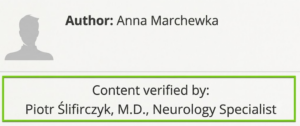
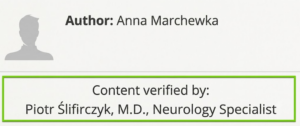
If the content author is not a medical expert (a copywriter, for example), add a note confirming medical review by a physician. The message can look like this:
Beyond on-site work, it is also worth building the authors’ digital footprint externally (Author Entities). If a doctor or medical expert comments for another medical portal, speaks at a conference, or publishes original research, make sure those publications include the doctor’s full name along with the medical company or facility where they practice.
Frequent mentions and topical associations from credible medical sources help algorithms understand what a given doctor does and strengthen their authority.
Citing Reliable Medical Sources (Trustworthiness)
Medical content should reference established, internationally recognized institutions and research. Citing hard data, statistics, and test results from medical centers builds trust in the brand and the article, which directly supports the T in E-E-A-T (Trustworthiness). Which sources are worth citing?
- Mayo Clinic, the prestigious American nonprofit medical center,
- CDC (Centers for Disease Control and Prevention), the US government’s public health agency,
- WHO, the World Health Organization,
- PubMed, the database of scientific literature in medicine.
On the Polish market, one of the most trusted medical sources is the Medycyna Praktyczna portal, alongside official government institutions such as GIS (the Chief Sanitary Inspectorate), the National Institute of Public Health, and the Agency for Health Technology Assessment, which regularly publishes research reports.
Business and Legal Transparency (Trustworthiness)
Transparent pricing and medical procedures. Clinic websites should clearly state the prices of medical services, treatments, and diagnostic tests, with no hidden extra costs. Patients should also be openly informed about contraindications, potential side effects, and what a procedure involves. Hiding real prices or failing to disclose known risks significantly lowers the algorithms’ trust in sites that do it.
Company details. The website footer should include information confirming the facility’s credibility. What belongs there?
- the full legal name of the entity,
- tax identification number (in Poland: NIP),
- statistical number (REGON),
- commercial register number (KRS, for companies),
- the entry number in the Register of Entities Performing Medical Activity,
- for individual doctors, their medical license number (in Poland: PWZ),
- full address,
- contact details.
Documenting the Real Experience of Staff and Patients (Experience)
The first letter of E-E-A-T stands for experience, and it also needs to be demonstrated and emphasized on the site. How?
- By sharing successes and publishing reports from original research – If a clinic uses innovative treatment methods, can point to high effectiveness of specific therapies, or has performed a complex operation, publish that on the site as news or blog articles.
- By publishing original multimedia – Your own photos of the facility, medical equipment, and staff stand out clearly against the stock imagery many companies still rely on. Video is worth adding too, in the form of expert commentary or interviews, which further underlines the company’s experience and expertise.
Managing External Reputation in the Medical Industry: Link Building and e-PR (Trustworthiness, Authoritativeness)
In the YMYL sector, an e-PR strategy and deliberate link building are essential tools for managing a company’s online image, and at the same time an effective way to build trust and authority.
In link building, drop mass-produced, cheap publications in favor of fewer but high-quality domains with a clear topical connection to the medical industry, publishing verified, high-quality content.
e-PR, in turn, is key to building the image of an expert and industry leader. It is worth running an online press office publishing media information, announcements, press releases, and optimized company descriptions. Monitoring mentions of the brand and its specialists across the web matters too, along with steadily acquiring new, valuable signals from high-authority sites.
Ignoring E-E-A-T will cost a brand patient trust, conversion drops (booked appointments, purchased tests), lower Google visibility, and reduced
Share of Voice in both search engines and AI engines.








 Wiktoria Wójciak



 Čeština
 French
 Spanish
 Portuguese
 Deutsch
 Turkish
 Dutch
Dutch
 Italiano
 Russian
 Romaian
 Portuguese (Brazil)
 Greek
Greek
 Slovenčina