

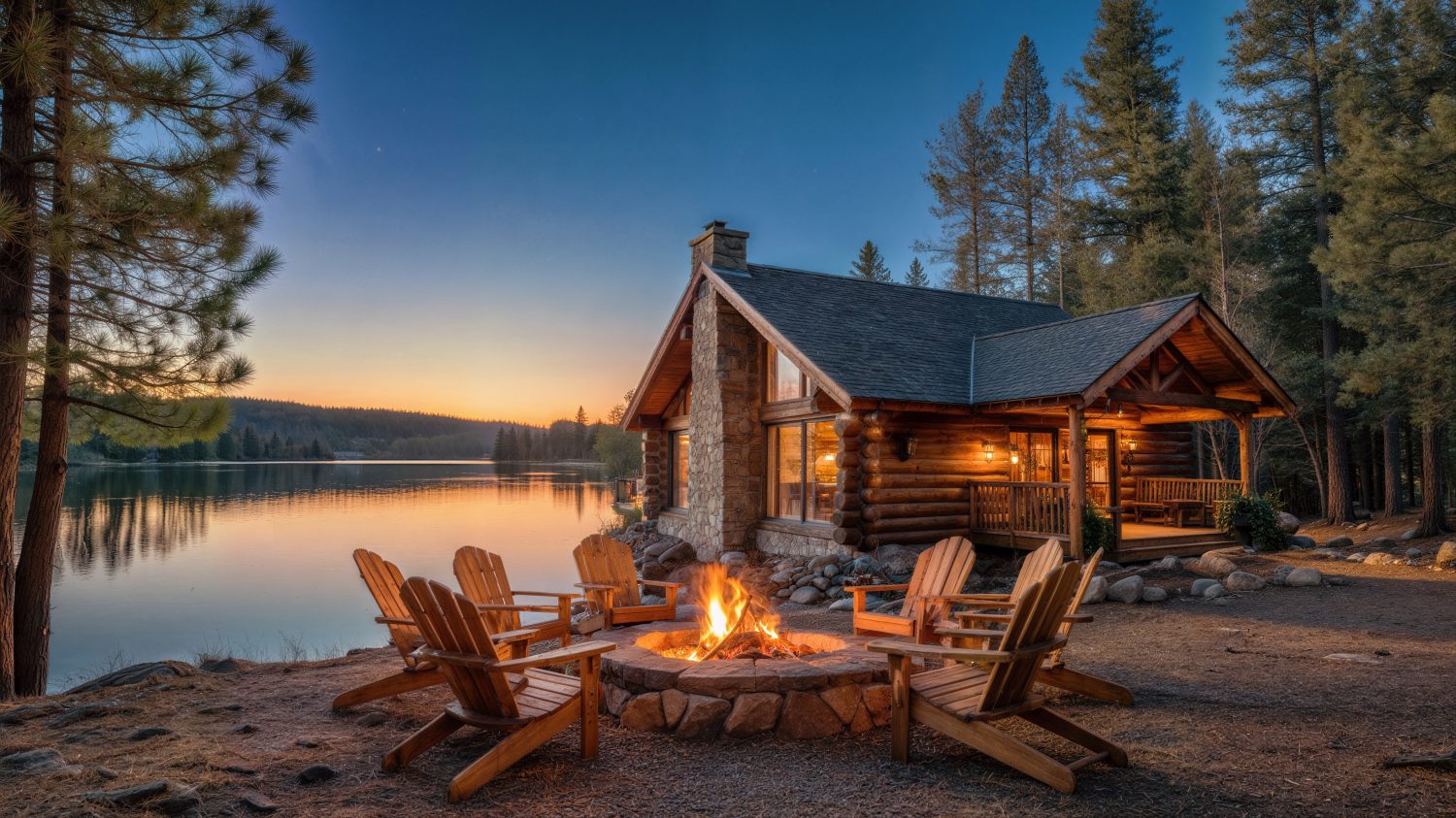
Leave the Family Cabin to Three Kids in a Will and They Inherit It at Today’s $480,000 Value. Deed It to Them This Year and They Split the $40,000 You Paid in 1979

He bought the lake cabin in his own name in 1979 for $40,000. Three kids spent their summers on that dock. At 74, he wanted the cabin out of his name and out of probate, so this fall he signed a quitclaim deed giving each child a one-third share.
He dies two years later. None of the children live near the lake, so they sell for $480,000, the same value it carried the day he signed. Their CPA asks for the cost basis. The answer is his 1979 price, split three ways.
Had the cabin passed under his will, the taxable gain on that sale would be zero. Because of the deed, the gain is $440,000.
Gifts Carry Old Basis While Inheritances Reset It
Two sections of the Internal Revenue Code decide this. Under 26 U.S.C. § 1015(a), property received as a gift keeps “the same” basis “as it would be in the hands of the donor”. The children take over his 1979 cost along with the deed.
Under 26 U.S.C. § 1014(a)(1), property acquired from a decedent takes a basis equal to “the fair market value of the property at the date of the decedent’s death”, and § 1014(b)(1) covers property received “by bequest, devise, or inheritance”. IRS Publication 530 puts it plainly: your basis in an inherited home is generally the FMV of the home on the date of the decedent’s death. Publication 550 adds that inherited capital assets count as long-term regardless of how long you held the property.
Running the Numbers on One Cabin
Assumptions: he was the sole owner, made no capital improvements, lived in a common-law state, and the cabin held at $480,000 through his death and the sale.
| Per child | Deeded in 2026 | Inherited by will |
|---|---|---|
| Sale proceeds | $160,000 | $160,000 |
| Basis | $13,333 | $160,000 |
| Taxable gain | $146,667 | $0 |
| Federal tax at 15% | $22,000 | $0 |
The 15% rate comes from the long-term capital gains schedule in 26 U.S.C. § 1(h)(1)(C), the bracket most middle-income heirs land in. Across three children, the deed costs the family $66,000 in federal tax before any state income tax.
The gift itself costs nothing at signing. Each child received $160,000 of value, above the 2026 annual exclusion of $19,000. The excess, $141,000 per child and $423,000 in total, goes on Form 709 and reduces his lifetime exemption. With the 2026 basic exclusion at $15,000,000, no gift tax is due.
Leaving It by Will Costs Zero Estate Tax
The step-up comes free at this size. A $480,000 cabin sits far below that $15,000,000 threshold. Only 7,195 federal estate tax returns were filed nationwide in 2024, and just 2,663 owed any tax.
Probate avoidance and the step-up can coexist. Under 26 U.S.C. § 1014(b)(2), property placed in a trust the owner can revoke at any time before death counts as acquired from the decedent. A revocable living trust skips probate and still resets basis to the fair market value at death. Many states also allow a transfer-on-death deed that does the same job for a single parcel. (The ownership, beneficiary forms, and trust choices that decide whether money goes to family or to lawyers are the whole subject of our free estate checklist, here: Die With a Plan.)
Reversing a Deed Comes With a One-Year Trap
Families who already transferred the cabin sometimes deed it back to the parent to recapture the step-up. Section 1014(e) blocks that if the parent dies within the 1-year period after receiving appreciated property back. The children then get the adjusted basis of such property in the hands of the decedent immediately before the death, the same old number.
Five Moves Before Anyone Signs a Deed
- Find the 1979 closing statement and every receipt for additions, roofs, or septic work. Improvements raise adjusted basis under Publication 551 and reduce the gain on either path.
- If the deed is already recorded this year, file Form 709 by April 15 of next year, the deadline the IRS sets for gifts above the annual exclusion.
- Have an estate attorney compare a revocable trust with a transfer-on-death deed in your state, using the cabin’s current appraisal.
- If you plan to undo an earlier gift deed, have the parent’s health and the one-year period in front of you before recording anything.
- At death, order a date-of-death appraisal. When no estate tax return is filed, Publication 530 says heirs use the appraised value of the home at the decedent’s date of death for state inheritance or transmission taxes.
One Number to Keep
A quitclaim deed signed this year turns a tax-free inheritance into $440,000 of taxable gain and a $66,000 federal bill split three ways. A will or revocable trust brings that bill to zero.
Released: The Definitive Guide to Retirement Income
(Sponsor) Most people spend their entire working lives focusing on one thing: growing a pile of money. Then they retire and discover the skill they actually need is close to the opposite. Turning that pile into steady income, year after year, through good markets and bad, without ever running out.
It may be the least discussed and most consequential transition in personal finance, and plenty of otherwise careful investors walk into it with no real plan. That is exactly what The Definitive Guide to Retirement Income helps answer. It is a free guide from Fisher Investments covering what your retirement will really cost, where the cash flow should come from, and how much you can safely withdraw each year. Learn more here. Learn More Here ›
Pôvodne publikované na 247wallst.com




