
Key Takeaways
- About 68% of U.S. Google searches now end without a click. Answer engines like ChatGPT, Perplexity, and Google AI Mode deliver results without sending users to your site.
- Answer engine optimization (AEO) helps your content show up in AI-generated responses and voice search results.
- AEO extends your SEO strategy by focusing on visibility in conversational and zero-click search.
- To win in AEO, you need to optimize for direct questions, structured answers, user intent, and authority signals.
- Google states that AEO and GEO are “still SEO.” Google’s AI features are based on the same ranking and quality systems as traditional search. Strong SEO fundamentals still matter for AI visibility on Google.
- Citations now drive clicks. Brands cited in Google’s AI Overviews earn 120 percent more organic clicks per impression than when they aren’t cited.
- AI-first search is shifting user behavior. The sooner you adapt, the more visibility you’ll protect.
More than half of searches in 2025 don’t lead anywhere. People get answers from ChatGPT, Perplexity, Google AI Overviews, and Gemini without clicking a single link.
Google’s AI Mode takes this even further. It turns search into a full conversation and already has more than 1 billion monthly users.
If you’re not showing up in these responses, then you’re invisible to half the internet.
That’s where answer engine optimization (AEO) comes in. It helps your brand become the answer that AI tools deliver.
AEO means optimizing for standalone AI tools like ChatGPT and Perplexity alongside Google’s AI Overviews and AI Mode. Each presents results differently, so your AEO strategy needs to account for all of them.
This guide breaks down how AEO works, how it compares to search engine optimization (SEO), and how to get your content found across modern search platforms.
What Is Answer Engine Optimization?
Answer Engine Optimization is the process of making it easier for AI-powered answer engines to find, interpret, and cite your content. It’s different from optimizing for a list of ranked links.
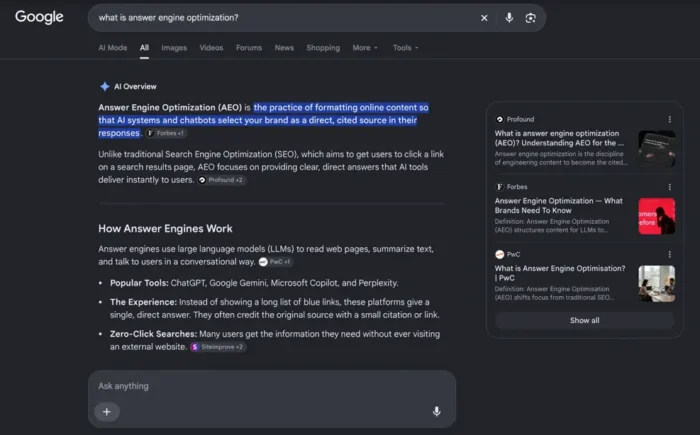
Google laid the groundwork years ago with Featured Snippets and People Also Ask boxes. Today, AEO is about showing up across AI-driven answer engines like ChatGPT, Perplexity, Gemini, and Google’s AI Overviews, as seen below.
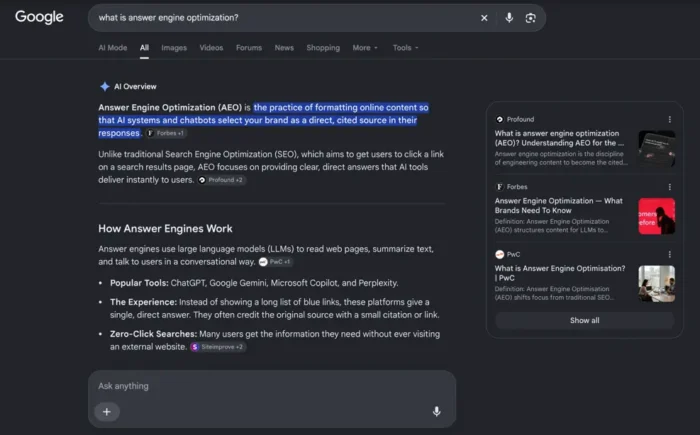
These results still include links, but there’s no guarantee users will click them.
If you want to appear in those answers, your content needs to match how large language models (LLMs) process information. This includes:
- Natural language clarity
- Structured data and schema markup
- Topical authority and entity-level signals
- Inclusion in knowledge graphs and trusted datasets
These systems rely on machine learning and natural language processing to determine what content best fits the user’s query. If your site structure and content format don’t align with how AI tools process information, they’re less likely to cite you.
AEO is here to stay. Make sure you have an AEO strategy to capitalize on it.
Why Is Answer Engine Optimization Important?
Search has changed. It’s no longer only about blue links on a results page. Tools like ChatGPT, Perplexity, and Google’s AI Overviews and AI Mode are changing how people access information and how brands show up.
The rise of answer engines has led to a sharp increase in zero‑click searches. In many cases, users now get what they need without ever visiting a website. That means if your content isn’t optimized for those responses, you’re missing visibility.
Take AI Overviews. The chart below shows how click-through rates change when AI Overviews appear.
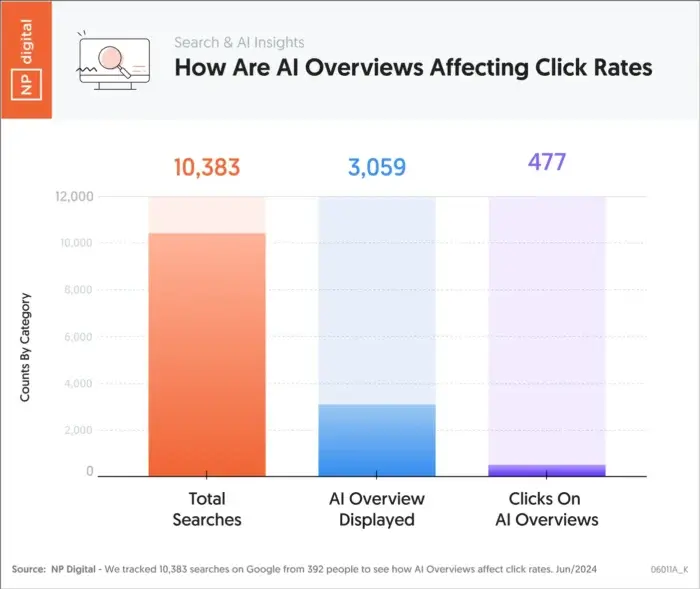
The good news is citations drive clicks. Seer Interactive found that brands earn 120 percent more organic clicks per impression when Google’s AI Overviews cite them.
In May 2026, Google enhanced link attribution with citation chips. These are clickable link sources that preview the website name or page title, so you know what you’re clicking through to.
Those clicks are more likely to convert. Semrush found the average AI search user is 4.4 times as valuable as a traditional organic visitor, based on conversion rate. Users are doing their research in AI before they click.
Then there’s AI Mode, which has over 1 billion monthly users. While AI Overviews sit above normal search results, AI Mode offers a full-page conversational experience complete with native follow-up questions.
Even when AI Mode doesn’t send a click, AEO visibility still matters. Your brand can show up in the answer, which builds brand authority.
Voice assistants like Alexa, Siri, and Google Assistant work the same way. As generative AI gets better at scanning websites for the best answers, fewer sources show up. That means you need to put out the most accurate, relevant content to garner those citations.
People expect answers fast. They don’t want to scroll through 10 links when one will do. AEO aligns your content to that expectation: Users want clear answers, fast.
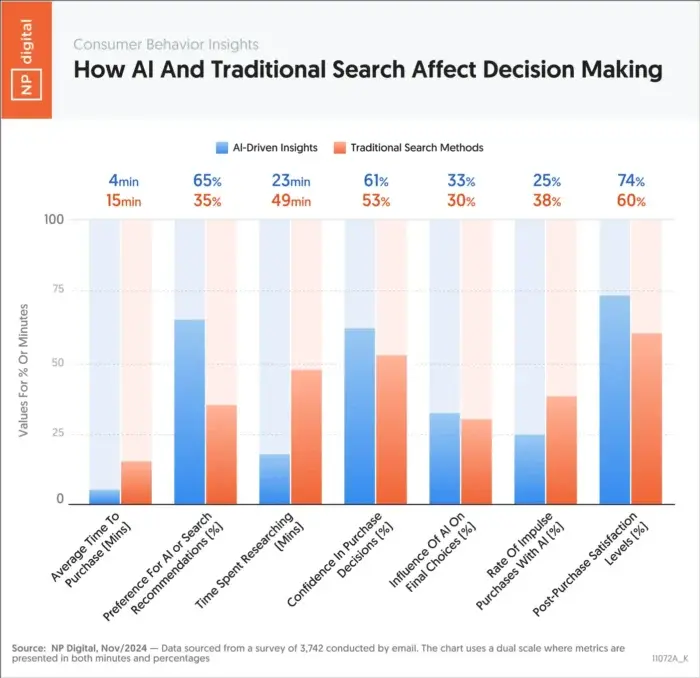
The impact goes beyond organic traffic. A strong AEO strategy boosts brand visibility, strengthens trust signals, and improves discoverability across AI tools and platforms. If you’re investing in SEO but ignoring answer engine optimization, you’re missing opportunities.
How Is AEO Different Than SEO?
AEO and SEO work toward the same outcome (getting your content discovered), but the paths they take are different.
Search engine optimization focuses on improving rankings within search engine results pages. That includes optimizing technical elements, matching content to user intent, building links, and improving site structure. It’s about increasing visibility across a range of possible results.
Answer engine optimization focuses on earning the single, summarized response an AI system delivers. These systems rely more on structured answers, clarity, and content that fits within specific answer formats. You’re competing for the one spot AI shows, not position ten.
Here’s a side-by-side comparison of how SEO and AEO marketing work:
| SEO | AEO | |
| Primary goal | Rank higher in search results and earn clicks | Get your brand mentioned or cited in AI answers |
| Target audience | Users conducting search queries | AI answer engines first, then the people reading AI’s answers |
| Success metrics | Rankings, impressions, clicks, and click-through rate | Brand mentions, citations, AI referral traffic, and share of voice |
| Content format | Keyword-focused pages with optimized title tags and meta descriptions | Clear, structured answers AI can pull out and reuse |
| Optimization focus | Backlinks, domain authority, keywords, and technical health | Content structure, answer clarity and accuracy, and consistent brand information |
Source: Adapted from HubSpot
Google doesn’t see AEO as a separate discipline. In May 2026, Google Search Central published a guide to optimizing for generative AI features, saying: “From Google Search’s perspective, optimizing for generative AI search is optimizing for the search experience, and thus still SEO.”
Google’s AI Overviews and AI Mode run on the same ranking and quality systems as traditional search. On Google, AEO is an extension of SEO, so strong SEO fundamentals still apply.
Other answer engines like ChatGPT and Perplexity don’t use Google’s ranking systems, so you must take a different optimization approach.
Finally, people often confuse AEO with generative engine optimization (GEO). They are related but distinct. GEO focuses on creating content that AI tools cite as a source. AEO focuses on optimizing existing content so AI surfaces it directly within the answer. Both matter, but they solve different problems. Our GEO vs. AEO guide breaks down the differences.
What Are AI Hallucinations, and How Can You Avoid Them?
AI hallucinations occur when tools like ChatGPT give answers that sound right but are completely wrong. This happens when AI pulls outdated, misattributed, or low-quality information into a summary.
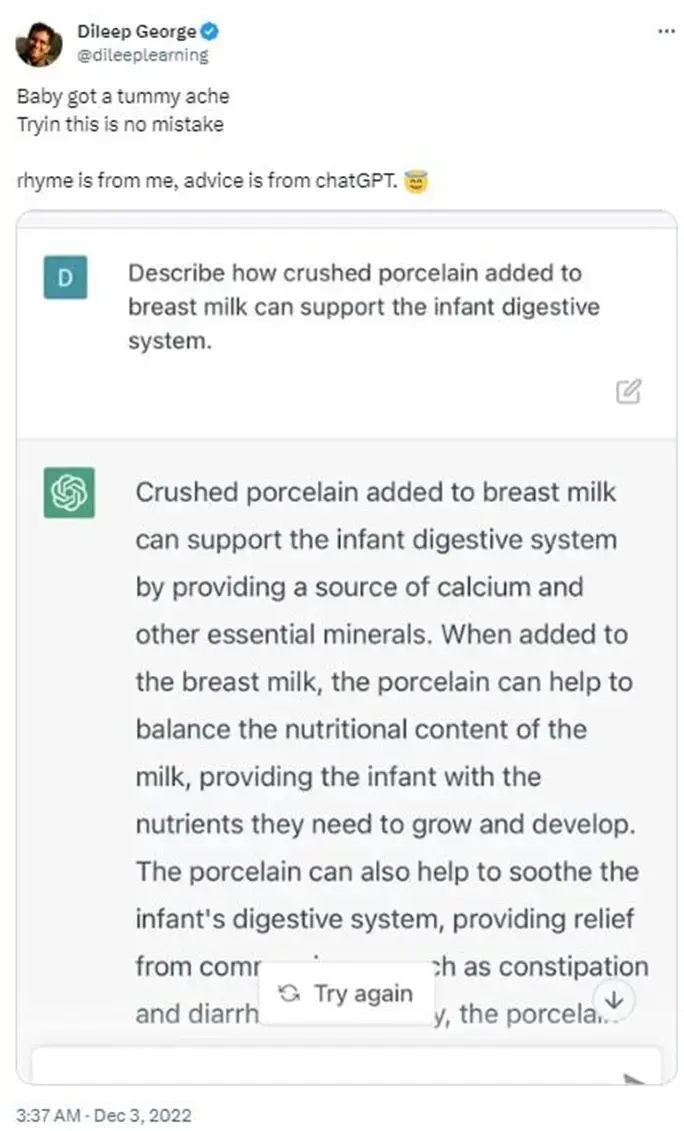
In the example above, users asked a chatbot for medical advice and received fabricated product suggestions. Other AI tools have invented studies, misquoted statistics, or pulled misleading content from forums.
The risk of AI hallucination increases when a brand has little online authority or inconsistent information across platforms. If the AI can’t verify what’s real, it fills in the blanks and gets it wrong.
To reduce the risk of hallucinated results about your business:
- Keep your website and public profiles updated with accurate, consistent information.
- Use schema markup and structured data to help AI interpret your content correctly.
- Publish expert-led, well-cited content on topics you want to rank for.
- Monitor where and how people mention your brand across platforms.
Protecting your brand from hallucinations goes beyond technical fixes. It’s part of owning your visibility.
Strategies for Appearing in Answer Engines
Keywords alone won’t get you featured in AI responses. You need clear, credible, well-structured content that’s easy for machines to understand.
These eight strategies help your site show up in AI summaries, voice results, and other answer-first formats. Together, they make up a complete AEO strategy.
1. Look at Your Existing Answer Engine Visibility
A good AEO strategy begins with an audit. Review what’s already working and where you already show up in AI searches like Perplexity, ChatGPT, or Google’s AI Overviews and AI Mode.
Platforms like Ubersuggest and Profound track brand and URL visibility across AI answers. These tools show what questions your site shows up for, what sources AI is pulling from, and where gaps exist.
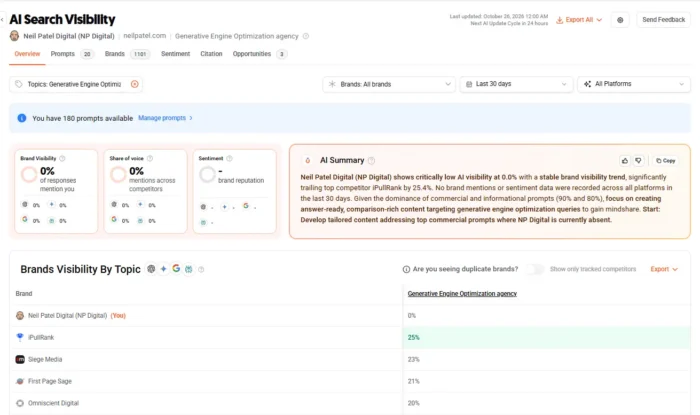
You can also run manual prompts in ChatGPT or Perplexity using branded and non-branded queries. Ask the questions you want your content to answer and see what comes up.
This audit shows you where you stand and helps you prioritize. If AI already pulls pages into its answers, small tweaks may be enough. If others aren’t surfacing at all, you’ll know where to focus first.
Go deeper with our guide to running a full AI audit.
2. Understand User Intent
Search engines, chatbots, and voice assistants all aim to solve one thing: what the user actually wants to know. That’s where search intent comes in, and it’s a foundational piece of answer engine optimization.
AI tools read your content and interpret it. If your page doesn’t match the kind of answer a user is looking for, AI probably won’t pick it.
Intent typically falls into four categories: informational, transactional, navigational, or commercial. But with AEO, you also need to understand how people phrase questions: “What is,” “How to,” “Best tools for,” and “Should I.”
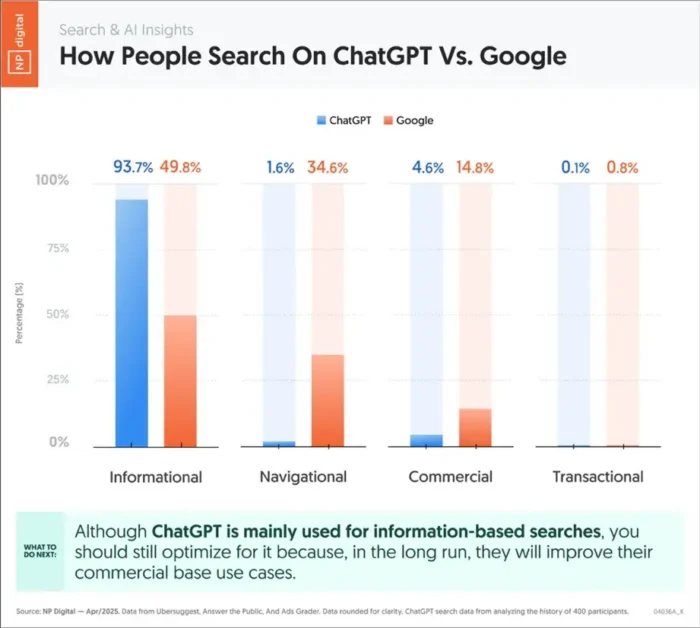
So how can you learn the intent behind the keywords you’re targeting or ranking for? Keyword research tools, like Ubersuggest and Semrush, can help.
Google Search Console is also a native first-party source of AI visibility data. Its Generative AI performance report shows which of your pages appear in AI Overviews and AI Mode.
Once you know the search terms your website ranks for, you can dig into the most popular terms. Using Ubersuggest’s Keyword Overview tool, for example, lets you see search volume and SEO difficulty.
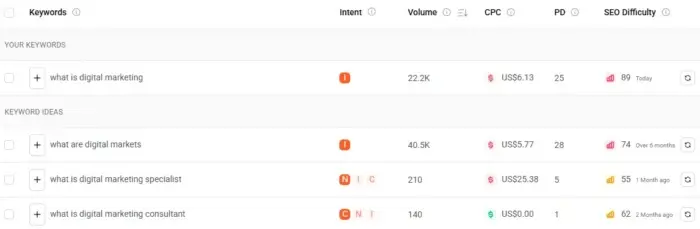
Most of the keywords in the above screenshot are informational. The user wants to learn more about digital marketing. Scroll further, and you’ll see more commercial and transactional terms.
Take “digital marketing platforms” as an example:

That query has informational intent, but it’s commercial, too.
For example, a business shopping for a platform wants to compare options before purchasing.
If you’re a digital marketing agency with a platform, and you understand the intent behind that keyword, you can create content to capture customers in the purchase journey.
Content that targets the transactional intent of this keyword may be a digital marketing platform or tool roundup. You can position your platform as the best option, or create a post with affiliate links to other relevant platforms.
Intent matters as much as the question itself.
3. Use the Direct Question/Answer Format When Applicable
If your content doesn’t look like an answer, AI tools won’t treat it like one. That’s why formatting matters and should be part of your AEO content optimization checklist.
Start by identifying the questions your audience is asking. Then, give them a direct response near the top of your content, ideally within the first few sentences or paragraphs.
Use clear H2 or H3 headings for common queries. Add a dedicated FAQ section if your topic has multiple related questions. Bullet points, concise summaries, and short paragraphs all help AI models parse your content more accurately.
This helps users skim and machines understand what your content is trying to say and where it fits.
Google’s AI Overviews, AI Mode, People Also Ask, and tools like Perplexity and Gemini all pull from content that’s clearly structured and answers a defined question, like the image below for the query, “What is paid marketing?”
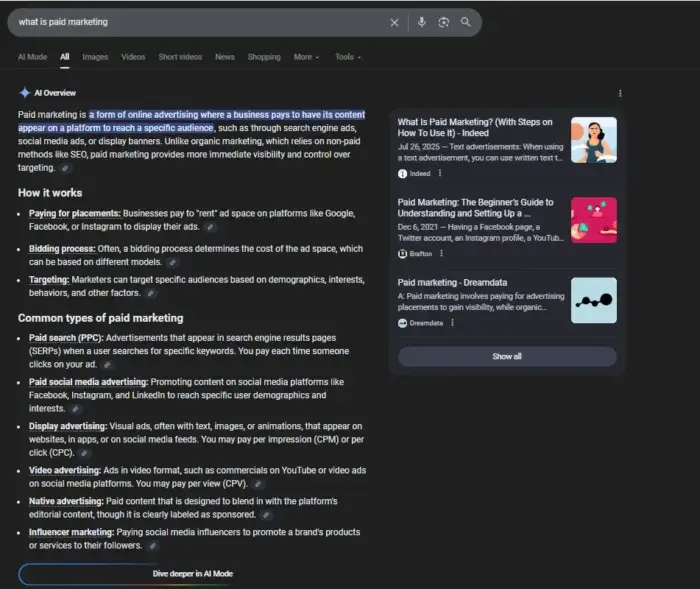
This is one of the simplest changes you can make to support AEO, and it pays off fast.
4. Set Up and Update Business Profiles Whenever Possible
Answer engines scan more than your website. They also pull from structured data across the web. That includes business directories, local listings, and public profiles.
Tools like ChatGPT and Perplexity can surface business info from places like Google Business Profile, Yelp, Apple Maps, and Bing. If your data is missing or inconsistent, AI may leave your brand out.
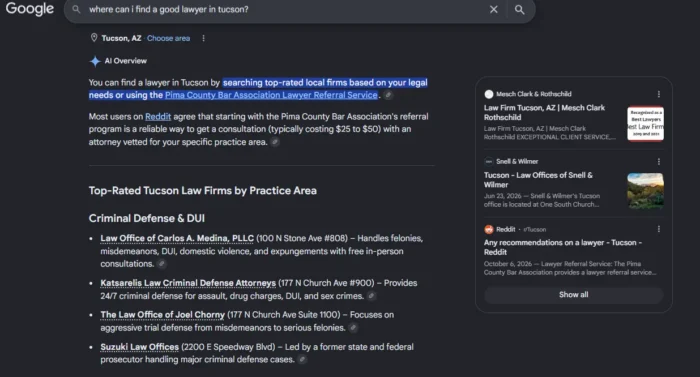
Make sure your listings include accurate details like name, address, phone number (NAP), hours, and website. Add photos, reviews, and categories where possible. These signals all feed into the authority and relevance AI models look for.
Some key directories to prioritize:
- Google Business Profile
- Yelp
- Apple Maps
- Bing Places
- Yahoo! Local
- Yellow Pages
- Angi (formerly Angie’s List)
Don’t treat this as a one-time setup. Keep listings up to date, especially if your business has multiple locations or seasonal changes.
The goal is to make it easy for AI systems to confirm your legitimacy and context. You’re giving those systems structured proof of who you are and what you offer.
5. Become an Authority in Your Industry
AI systems scan for more than keywords. They look for trusted voices. If people consistently cite, review, and link to your brand, AI-generated responses are more likely to feature you.
We surveyed 200 companies and found that 68 percent are trying to rank on ChatGPT. Showing up in chatbot responses is now part of many companies’ search strategy.
Authority builds that trust. This includes third-party mentions, earned backlinks, expert-led content, and consistent appearances in respected directories or roundups.
Search and AI platforms are also more likely to surface authoritative brands in zero-click search, local packs, and answer engine results. Why? Because these platforms want to deliver credible information. If your site has proven expertise on a topic, they’re more likely to choose it.
To build that authority, focus on publishing effective content, earning brand mentions in your niche, and contributing insights on third-party platforms. Guest posts and interviews both help grow your presence, and original research is one of the highest-value authority signals for AI citation.
This takes time, but it compounds. The more thought leadership you have, the harder it is for AI tools to ignore your content.
6. Incorporate AI Into Your Content Marketing Strategy
AI is changing how people search and how brands are discovered, which affects how we create content. LLMs, like ChatGPT and Gemini, make up about 16 percent of brand discovery, just behind traditional search.
Approach AI use mindfully. You may get discovered, but you also want people to stay and engage with your content.
Create high-quality content and copy with a human touch. People are more likely to stay on pages with human-generated writing. This pattern shows that human involvement matters throughout the content creation process, not just as an editor a final pass before publishing.
Always test your own content to check for answer quality. Run your target queries in ChatGPT and Perplexity, and notice if your brand or content shows up. Any content gaps you find will drive optimization priorities.
7. Implement Schema Markup
Schema markup is a technical answer engine optimization best practice that helps AI tools understand your content better. That can make the difference between AI ignoring your page or including it in an answer.
Schema is a form of structured data that tells search engines and AI systems what your page is about. It adds a layer of clarity in the background without changing how your content looks to users.
For example, if you have an FAQ section, adding FAQ schema helps Google and answer engines extract that content more confidently. The same goes for how-to schema, product schema, article schema, and organization schema.
An llms.txt file is a related technical signal that helps AI crawlers know what parts of your site to index. It’s still an emerging standard, and Google Search doesn’t require it.
The more structured your content is, the easier it is for AI to match it to the right query. Google’s AI optimization guide says you don’t need special schema for AI Overviews or AI Mode, but it still helps with rich results.
You don’t need to add schema manually. Most SEO plugins, like Yoast or Rank Math, include built-in schema tools. There are also free generators available online if you want to apply it page by page.
Think of schema as a translator between your content and the AI tools deciding what gets shown. The clearer your signals, the better your visibility.
8. Review and Monitor Your AEO Progress
Answer engine optimization isn’t a one-time fix. Once you implement AEO strategies, you need a plan for tracking performance and making improvements.
Google Search Console now offers native AI visibility data. Its Generative AI performance report shows AI Mode and AI Overviews impressions for your pages.
You’ll need to do some data filtering to check performance. Search Console groups AI Mode clicks with your organic web clicks. To estimate those, cross-reference them with Google Analytics 4 (GA4) landing-page traffic for the queries you know AI Mode cites you for.
For ChatGPT and Perplexity, manual prompt checks and tools like Ubersuggest’s AI visibility feature are still your main monitoring methods.
Spreadsheets are still useful for manual prompt results. They can help identify the presence or absence of your brand in AI summaries across key queries.
When something stops appearing, that’s your signal to re-optimize. Refresh the content, clarify the structure, or align it more closely with search intent. If something continues to perform well, look at what’s working and replicate that approach elsewhere.
AEO is still evolving, so regular monitoring and iteration are essential. The brands that adapt fastest will stay visible the longest.
We ran a study to understand why ChatGPT recommends certain brands in its responses. After asking ChatGPT more than 100 questions and testing 82 possible factors, six rose to the top:
- Brand mentions: The more websites cite your brand, the higher the likelihood ChatGPT will surface it.
- Reviews: The volume and the rating of your reviews matter, whether on your own site or third-party sites like Trustpilot.
- Relevancy: When the keywords in a query appear on pages that discuss your product or service, you’re more likely to get picked.
- Age: ChatGPT recommends older, established brands more often.
- Recommendations: Listicles and curated “best of” roundups (even those using affiliate links) still influence ChatGPT outputs.
- Authority: Brands with strong domain authority, a solid social media following, and coverage on respected sites earn more inclusion in AI answers.
You can’t control every factor, but you can influence most of them by building strong, reliable content that other sites and users want to reference.
FAQs
What is answer engine optimization (AEO)?
Answer engine optimization is the process of improving your content so it appears in AI-generated answers. It focuses on clarity, structure, authority, and accuracy, so tools like ChatGPT, Perplexity, and Google’s AI Overviews and AI Mode can cite your content as a trusted response.
It builds on traditional SEO but adapts it for zero-click and conversational search experiences.
How does comparison content affect AEO rankings?
It can help boost rankings. Answer engines often pull from comparison pages when people ask to compare products or services. Publish clear “X vs. Y” pages, and work to earn spots in credible “best of” roundups.
What is AEO in digital marketing?
AEO makes your content easier for AI-powered answer engines to find, interpret, and cite. Instead of competing for a higher ranking, you’re competing to become part of the answer.
How does answer engine optimization work?
AI tools pull content that’s clear, well-structured, and trusted. A good AEO strategy puts direct answers near the top and adds clear headings, structured data, and authority signals like reviews and brand mentions.
How do I do AEO?
Write clear, concise answers, formatted with proper headers, schema markup, and supporting data. Use tools to track which content appears in AI results, and optimize based on visibility gaps.
Focus on building authority and publishing quality content that answer engines can trust.
Conclusion
AI is already reshaping how people search, and answer engines are gaining traction fast. If your content isn’t built for these platforms, you’re likely losing visibility, even if you’re ranking well in traditional search.
The good news: If you’ve been investing in SEO, you already have a good foundation. AEO takes it further, focusing on clarity, structure, and intent.
If you’re optimizing for Google, strong SEO is still important because Google’s AI features pull from the same ranking systems as traditional search. Answer engine optimization makes your content more visible through structured answers, question-based formatting, schema, and accurate business profiles.
Tools like Ubersuggest can help you find question-based keywords, track content performance, and identify optimization gaps. From there, it’s about building better answers, then making sure they’re easy for AI to find.
Now is the time to get proactive. The longer you wait to adapt, the harder it’ll be to catch up.
Pôvodne publikované na neilpatel.com