

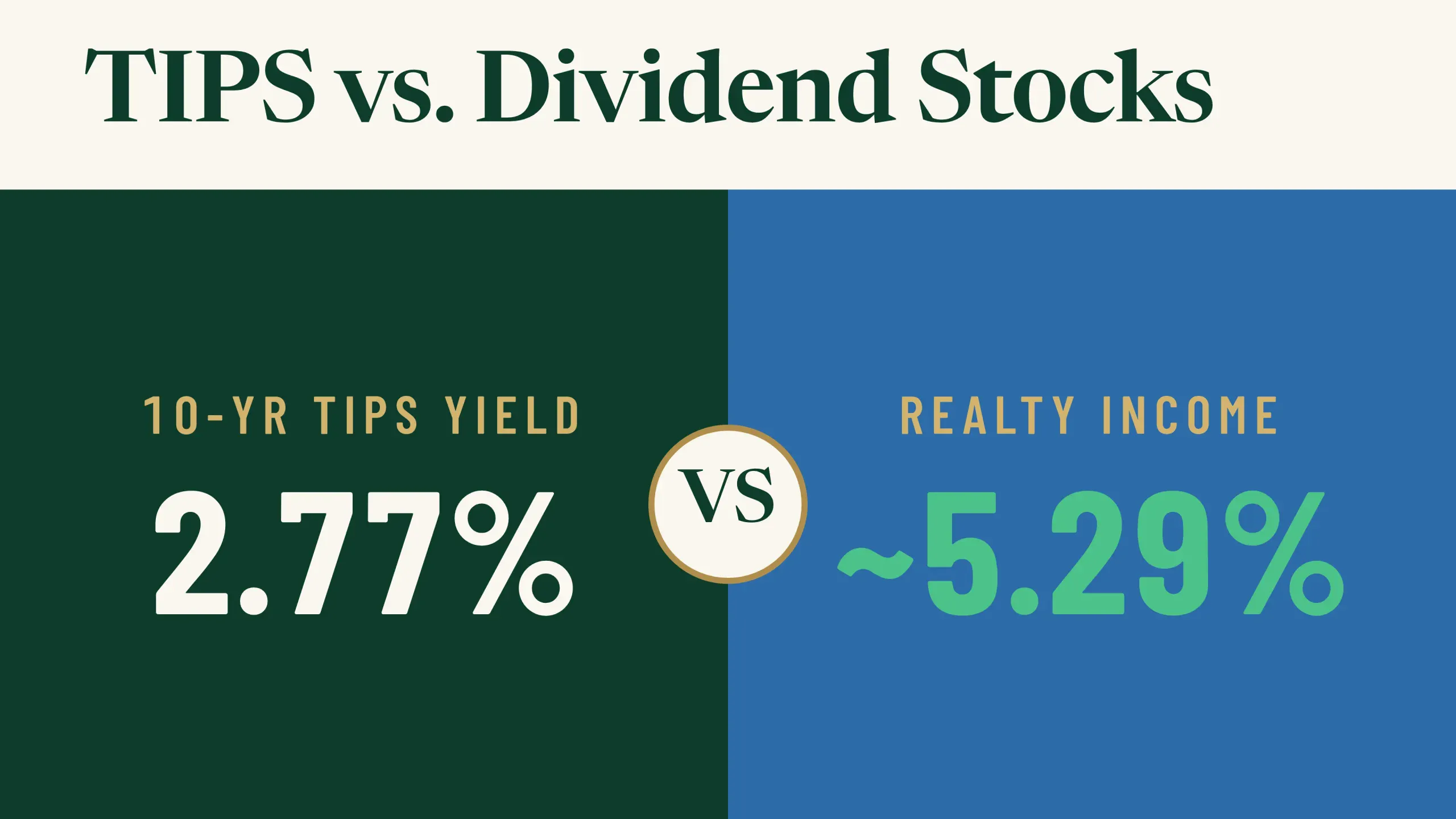
10-Year TIPS Pay 2.77% Above Inflation. Here’s How Dividend Stocks Compare

As of the November 20, 2026 record date, Treasury Inflation-Protected Securities (TIPS) carried a real yield of 2.53% at the 5-year maturity and 2.77% at the 10-year maturity. The curve rises to 3.17% at 30 years. A real yield is the return above inflation, because TIPS principal moves with the Consumer Price Index. That matters now: consumer prices rose about 3.7% in the year through September 2026, and Social Security’s 2027 cost-of-living adjustment came in at 3.6%, up from 2.8% for 2026. This month’s Income Desk puts that inflation-linked Treasury coupon up against three dividend stocks retirees know well.
How TIPS Pay You: Inflation-Adjusted Principal and a Fixed Real Coupon
The Treasury sells TIPS in 5-, 10-, or 30-year terms, with a $100 minimum purchase. The mechanics come down to three moving parts:
- Principal tracks inflation. Principal rises with inflation and falls with deflation, using the Bureau of Labor Statistics CPI. The CPI-U index climbed from 325.252 in January 2026 to 337.511 in October 2026, and that increase gets written into TIPS principal.
- The coupon rate is fixed; the check is variable. The rate is set at auction and paid every six months until maturity. Because interest is calculated on the adjusted principal, each payment’s dollar amount changes as principal changes.
- Maturity has a floor. At maturity, the holder receives the inflation-adjusted principal or the original principal, whichever is greater.
The yields quoted above float every trading day. The 5-year real yield was 2.31% on November 2 and 2.68% on November 16, before ending at 2.53% on November 20; an investor locks in a real yield only by buying a specific TIPS and holding it to maturity.
That rise in early November also shows price risk. When real yields rise, the market prices of TIPS already issued fall. Selling before maturity can still produce a loss for a retiree, even though the Treasury never missed a payment. The U.S. government backs the interest and principal it owes. That backing does nothing to protect the market value of a TIPS sold early. The deflation floor also applies only to original principal at maturity.
Two more gaps matter for retirees. The first is reinvestment risk: when a TIPS matures, the real yield available on a new one could be lower than today’s. The second is the index. TIPS adjust with the CPI.
The Bureau of Labor Statistics’ research index for Americans 62 and older (R-CPI-E) weights housing and medical care more heavily. It reached 368.8 in October 2026, the highest observation in its recent series. A retiree whose own costs rise faster than the CPI gets less protection from TIPS than the headline adjustment suggests.
Dividend Safety Comes First: Where Realty Income, PepsiCo and Coca-Cola Stand Against a TIPS Coupon
Each side of the trade has a clear strength and a clear weakness. A TIPS coupon cannot be cut. The U.S. government owes it, and the inflation adjustment comes automatically. A dividend can be cut, because the board decides it every time it declares one.
A dividend can also grow faster than inflation, while a TIPS payment grows only by the inflation adjustment. Dividend yields are nominal, and TIPS real yields come on top of inflation. Putting them side by side overstates the dividend’s advantage.
| Income Source | Current Yield | Pays | Most Recent Raise | Main Threat to the Payment |
|---|---|---|---|---|
| 10-year TIPS | 2.77% real (Nov. 20, 2026) | Every six months | Inflation adjustment only | Price risk if sold early; reinvestment risk |
| Realty Income (NYSE:O) | ~5.29% (Nov. 21, 2026) | Monthly | 0.7% YoY (Q3 dividends paid) | Tenant credit, interest rates, capital access |
| PepsiCo (NASDAQ:PEP) | ~3.99% (Nov. 21, 2026) | Quarterly | 4.0% | Margin and North America demand pressure |
| Coca-Cola (NYSE:KO) | ~2.10% (Nov. 21, 2026) | Quarterly | 3.9% | Valuation risk to what investors pay for the stock |
Realty Income: Highest Payout, Slowest Raises
Realty Income announced its 116th consecutive quarterly dividend increase in September 2026. Its latest monthly payment is $0.274, up from $0.2715. Coverage looks solid. Adjusted funds from operations (AFFO), the REIT industry’s main measure of cash available for dividends, came in at $1.12 per share in Q3, up 3.7% from a year earlier. Occupancy stood at 98.8%, and management raised 2026 AFFO guidance to $4.45-$4.46. Dividend growth is slow. Q3 dividends paid totaled $0.813 per share, up only 0.7% from $0.807 a year earlier. That lags CPI inflation by a wide margin, so the stock’s real income is shrinking even as the dividend streak continues. The payout also depends on tenants paying rent and on the company’s access to debt and equity markets, two risks a Treasury coupon does not carry.
PepsiCo: Raises Ahead of Inflation, Earnings Behind
PepsiCo raised its quarterly dividend to $1.48 from $1.4225, an increase of about 4.0%, a bit faster than CPI inflation. The 2026 plan includes $7.9 billion in dividends, and interest coverage is 10.3x. Earnings growth is slowing. Its full-year core EPS growth guidance was lowered to +2.5% to +3.5%, and core operating margin contracted 35 bps on rising input cost inflation.
Core operating profit in its North America food business fell 12%. Barron’s weighed in on those North American problems and cut the stock to Sell. Raises that outpace earnings growth eat into the cushion that protects the dividend. The input-cost squeeze is the same inflation that TIPS principal absorbs automatically.
Coca-Cola: The Most Durable Raise Record, the Thinnest Yield
Coca-Cola has raised its dividend for 60+ years. The quarterly payment rose to $0.53 from $0.51, about 3.9%. The company raised its 2026 free cash flow guidance to at least $13.0 billion and comparable EPS growth to at least 11%, which gives it the strongest earnings backing of the three. Its ~2.10% yield sits below the 10-year TIPS real yield even before the TIPS inflation adjustment is counted.
At roughly 32 times earnings, Barron’s noted the valuation is the highest in 25 years. The dividend looks secure. The risk sits in the valuation.
Taxes Can Flip the Answer: Phantom Income Versus Qualified Dividends
TIPS interest is subject to federal income tax, and Treasury interest is exempt from all state and local income taxes. The catch is the principal adjustment. Under Treasury regulations, an upward inflation adjustment is taken into account for each taxable year the bond is outstanding, and a positive adjustment is OID (original issue discount), which is taxed as interest. In practice, a retiree who holds TIPS outside a tax-advantaged account owes federal tax every year on inflation gains that will not be paid out until maturity. This is known as phantom income, and it grows as inflation rises. Holding TIPS in an IRA or other tax-deferred account avoids the problem while the money stays inside the account.
Dividends are taxed in the year they are paid, so the tax bill always arrives with cash. Qualified dividends, which typically include those from PepsiCo and Coca-Cola when holding-period rules are met, are taxed at the same rates as profits on assets held more than a year because the tax code adds qualified dividend income to net capital gain. REIT dividends are subject to the REIT rules, so most of Realty Income’s payout is typically taxed as ordinary income. Qualified REIT dividends can, however, count toward a separate deduction under Section 199A. Dividends are also generally subject to state income tax. For retirees in high-tax states, that difference favors TIPS.
Who Each Option Suits
TIPS suit retirees who need a fixed amount of purchasing power for known expenses over a set horizon, can hold to maturity, and have room in a tax-deferred account to avoid the phantom-income bill. Coca-Cola and PepsiCo suit retirees with longer horizons who can ride out price swings and a possible dividend cut in return for raises that have recently kept pace with inflation, taxed at qualified rates. Realty Income suits investors who put the most weight on high monthly cash today and accept that its raises currently trail inflation and that its payout depends on tenants and credit markets.
Released: The Definitive Guide to Retirement Income
(Sponsor) Most people spend their entire working lives focusing on one thing: growing a pile of money. Then they retire and discover the skill they actually need is close to the opposite. Turning that pile into steady income, year after year, through good markets and bad, without ever running out.
It may be the least discussed and most consequential transition in personal finance, and plenty of otherwise careful investors walk into it with no real plan. That is exactly what The Definitive Guide to Retirement Income helps answer. It is a free guide from Fisher Investments covering what your retirement will really cost, where the cash flow should come from, and how much you can safely withdraw each year. Learn more here. Learn More Here ›
Pôvodne publikované na 247wallst.com




