


Hungary Votes Soon: Media Hype and Fake Polls vs. Viktor Orbán’s Real Voter Base
Only 11 days remain until Hungary’s decisive parliamentary elections on April 12—and the liberal public sphere is already in full spin: inflated polls are being used to portray Péter Magyar and his Tisza Party as inevitable winners, while simultaneously laying the groundwork to explain away a potential defeat.
Liberal pollsters and international media present this as fact: the Brussels- and Kyiv-backed opposition challenger is unstoppable, leading by double digits—as if no votes were left for anyone else. The same ecosystem produces these numbers and then amplifies them across liberal and global media, each reinforcing the other’s claims. Echo chamber at its finest.
Yet reality has a habit of intervening—and it will on election day.
Reality check: turnout vs. polling fiction
In the 2022 parliamentary election, official data from Hungary’s National Election Office recorded turnout at exactly 69.59%—5,717,182 citizens cast their ballots. Only twice since the first free elections in 1990 has participation exceeded that level.
Today, however, widely circulated ‘independent’ polls present a very different picture. The Medián survey—heavily cited in international media—projects an astonishing 89% turnout. This is difficult to take seriously, as it ignores a basic political reality: elections are decided by committed voters who actually show up, not by hypothetical enthusiasm measured in surveys.
And in Hungary, the governing parties possess precisely that advantage: a stable, disciplined, and highly mobilised voter base.
How elections are actually won in Hungary
Hungary’s electoral system is straightforward for international observers: 106 single-member constituencies decided by first-past-the-post, complemented by proportional party-list mandates in a 199-seat National Assembly. This structure rewards real local support and effective mobilisation—areas where the governing patriotic forces consistently outperform.
Fidesz–KDNP has built a nationwide, battle-tested base that turns out reliably, election after election.
The latest constituency projection by the Nézőpont Institute (published March 31, 2026) cuts through the noise. Using a combination of electoral history, nationally adjusted polling, and fresh local surveys in 30 districts, it estimates:
- 66 districts likely to go to the patriotic Fidesz-KDNP candidates led by Prime Minister Viktor Orbán
- 39 districts for the Tisza Party led by opposition leader Péter Magyar
- 1 district for a Tisza-linked independent
Of these, 44 districts are firmly pro-government, while only 27 are safely in opposition.
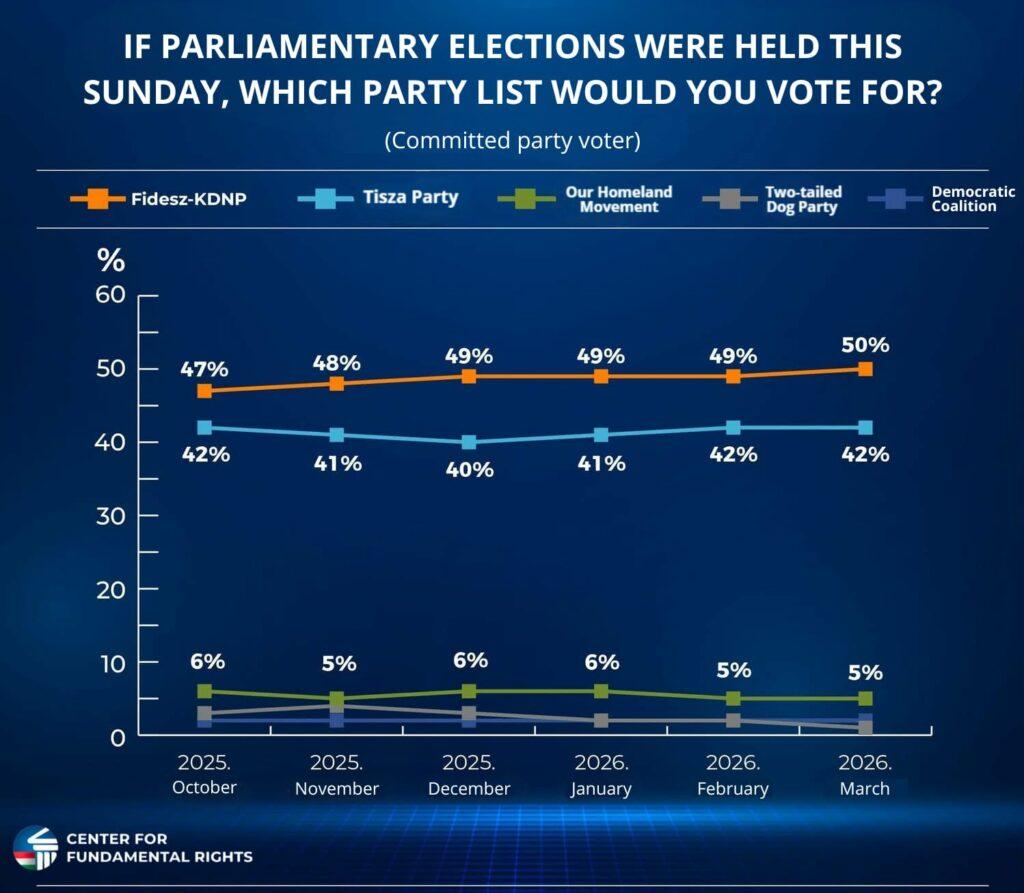
A separate nationwide, representative poll by the Alapjogokért Központ reinforces this picture. Among committed voters, Fidesz–KDNP stands at 50%, compared to 42% for Tisza, with turnout willingness rising to 74%. This suggests that the governing parties are approaching their 2.8 million voter base from 2022.
The trend reflects consistent growth over recent months, while Tisza has stabilised without breakthrough. Voters have also shown clear resistance to narratives of foreign interference and to policy proposals that would increase energy costs, while Prime Minister Viktor Orbán’s nationwide campaign continues to strengthen mobilisation.
In Hungary’s electoral system, such high and disciplined turnout has historically favoured the most stable political force—a dynamic clearly reflected in current data.
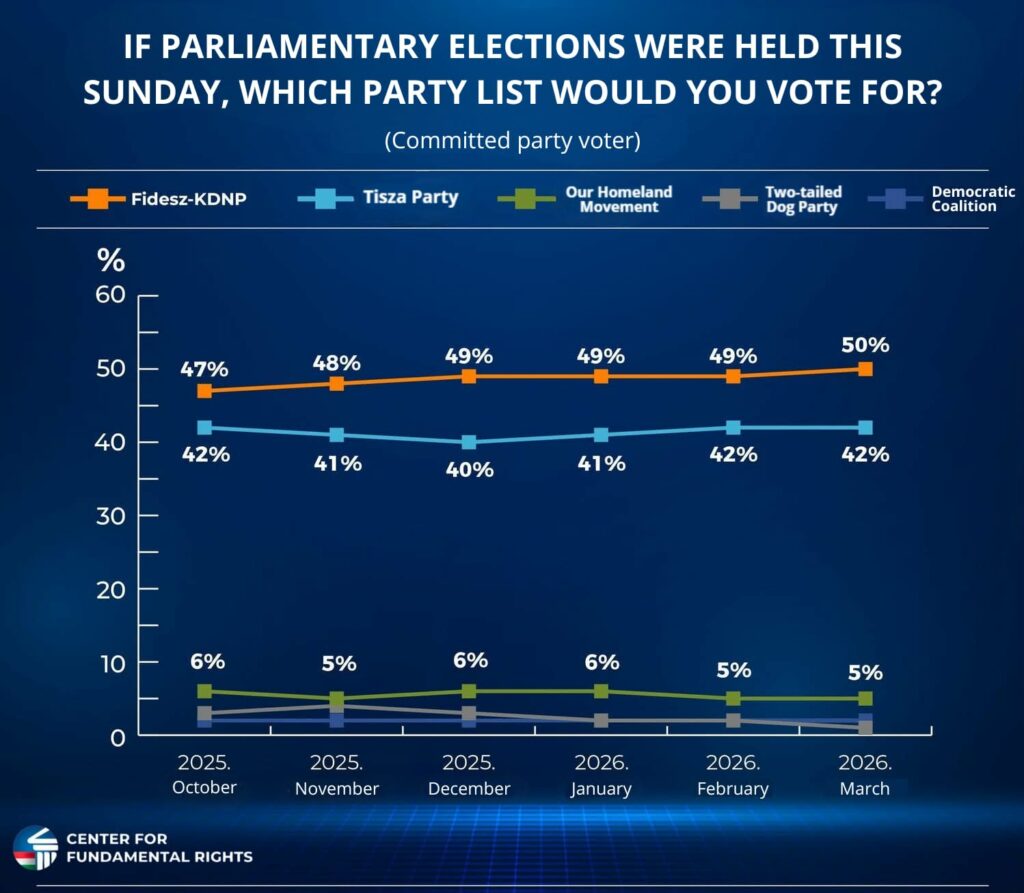 Source: Center for Fundamental Rights
What the narrative ignores
While Prime Minister Viktor Orbán draws large crowds across the country, Péter Magyar’s countryside appearances reveal a different reality. In many provincial towns, his message simply does not resonate. It appears to travel more effectively in Brussels—or Kyiv—than among Hungarian voters facing the direct consequences of war in neighbouring Ukraine, rising energy prices, and questions of national sovereignty.
This is clearly reflected in the Nézőpont Institute’s latest data: Fidesz dominance is strongest in rural, small-town, and village-based constituencies across multiple counties, while Tisza performs better in Budapest and a handful of larger cities. Even so, the broader electoral map remains decisively tilted toward the governing side.
Pre-packaged loser’s alibi
As the final days of the campaign unfold, Péter Magyar and the pro-Ukraine, Brussels-aligned network backing him are already internationalising doubts about Hungary’s elections. Key allies in this ecosystem—including Radosław Sikorski and Anne Applebaum—have openly raised the prospect of “unfair” elections, signalling that the narrative is ready. Even Brussels-based outlets like Politico now run daily pieces suggesting that while Péter Magyar is supposedly far ahead, victory somehow remains uncertain—a contradiction that speaks for itself.
The same Brussels- and Kyiv-aligned ecosystem that produces inflated polling numbers and amplifies them through legacy media is now preparing the next step: if Péter Magyar wins, it is democracy; if he loses, it must be fraud or ‘foreign interference.’ We have seen this playbook before.
At its core are networks that blur the line between journalism and political operations. Figures such as Szabolcs Panyi—linked to the George Soros network and previously to USAID-funded media structures—have played a central role in constructing and circulating intelligence-style narratives about alleged Russian operations in Hungary. As seen in the case of Donald Trump and virtually every patriotic political force resisting external pressure, the same ‘Russia hoax’ pattern emerges: constructed claims built on anonymous sourcing, designed to frame and weaken sovereign governments, then rapidly amplified by international legacy media as established fact.
From there, the echo chamber does the rest.
The objective is clear: not to protect electoral integrity, but to shape the narrative in advance—questioning the integrity of the 2026 elections and internationalising that claim in order to minimise the political costs of a potential defeat.
This is precisely why these narratives are being constructed now.
Hungarians have consistently demonstrated a clear sense of responsibility in decisive moments—and there is every reason to believe they will not disappoint the sane part of the international community.
And when the patriotic forces led by Viktor Orbán prevail on April 12—as every reality-based poll clearly indicates—this carefully constructed narrative will inevitably give way to the facts, making clear once again: Hungary’s future is decided by its citizens, not by external interests or international media campaigns.



- News
- Art
- Cars and Vehicles
- Crafts
- Beauty
- Dance
- Dating
- Drinks
- Film
- Fitness
- Fishing and Hunting
- Food and Recipes
- Jogos
- Gardening
- Health
- Início
- Literature
- Lifestyle
- Local Business
- Music
- Marketing
- Networking
- Nature
- Outro
- Party
- Religion
- Shopping
- Sports
- Theater
- Tech
- Travel and Events
- Wellness
- Endereço Web

 English
 Čeština
 French
 Spanish
 Deutsch
 Turkish
 Dutch
Dutch
 Italiano
 Russian
 Romaian
 Portuguese (Brazil)
 Greek
Greek
 Slovenčina